

Thursday, July 5, 2018
...the most haunted house in England

*Pulled from other sources
Borley Rectory was a Victorian house that gained fame as "the most haunted house in England" after being described as such by psychic researcher Harry Price. Built in 1862 to house the rector of the parish of Borley and his family, it was badly damaged by fire in 1939 and demolished in 1944. The large Gothic-style rectory in the village of Borley had been alleged to be haunted ever since it was built. These reports multiplied suddenly in 1929, after the Daily Mirror published an account of a visit by paranormal researcher Harry Price, who wrote two books supporting claims of paranormal activity.
The uncritical acceptance of Price's reports prompted a formal study by the Society for Psychical Research (SPR), which rejected most of the sightings as either imagined or fabricated and cast doubt on Price's credibility. His claims are now generally discredited by ghost historians. Neither the SPR's report nor the more recent biography of Price has quelled public interest in these stories, and new books and television documentaries continue to satisfy public fascination with the rectory. A short programme commissioned by the BBC about the alleged manifestations, scheduled to be broadcast in September 1956, was cancelled owing to concerns about a possible legal action by Marianne Foyster, widow of the last rector to live in the house.
The first paranormal events reportedly occurred in about 1863, since a few locals later remembered having heard unexplained footsteps within the house at about that time. On 28 July 1900, four daughters of the rector, Henry Dawson Ellis Bull, saw what they thought was the ghost of a nun at twilight, about 40 yards (37 m) from the house; they tried to talk to it, but it disappeared as they got closer. The local organist, Ernest Ambrose later said that the family at the rectory were "very convinced that they had seen an apparition on several occasions". Various people claimed to have witnessed a variety of puzzling incidents, such as a phantom coach driven by two headless horsemen, during the next four decades. Bull died in 1892 and his son, the Reverend Henry ("Harry") Foyster Bull, took over the living.
On 9 June 1928, Harry Bull died and the rectory again became vacant. In the following year, on 2 October, the Reverend Guy Eric Smith and his wife moved into the house. Soon after moving in, Smith's wife, while cleaning out a cupboard, came across a brown paper package containing the skull of a young woman. Shortly after, the family reported a variety of incidents including the sounds of servant bells ringing despite their being disconnected, lights appearing in windows and unexplained footsteps. In addition, Smith's wife believed she saw a horse-drawn carriage at night. The Smiths contacted the Daily Mirror asking to be put in touch with the Society for Psychical Research (SPR). On 10 June 1929 the newspaper sent a reporter, who promptly wrote the first in a series of articles detailing the mysteries of Borley. The paper also arranged for Harry Price, a paranormal researcher, to make his first visit to the house. He arrived on 12 June and immediately phenomena of a new kind appeared, such as the throwing of stones, a vase and other objects. "Spirit messages" were tapped out from the frame of a mirror. As soon as Price left, these ceased. Smith's wife later maintained that she already suspected Price, an expert conjurer, of falsifying the phenomena. The Smiths left Borley on 14 July 1929 and the parish had some difficulty in finding a replacement. The following year the Reverend Lionel Algernon Foyster (1878–1945), a first cousin of the Bulls, and his wife Marianne (née Marianne Emily Rebecca Shaw) (1899–1992) moved into the rectory with their adopted daughter Adelaide, on 16 October 1930. Lionel Foyster wrote an account of various strange incidents that occurred between the time the Foysters moved in and October 1935, which was sent to Harry Price. These included bell-ringing, windows shattering, throwing of stones and bottles, wall-writing and the locking of their daughter in a room with no key. Marianne Foyster reported to her husband a whole range of poltergeist phenomena that included her being thrown from her bed. On one occasion, Adelaide was attacked by "something horrible". Foyster tried twice to conduct an exorcism, but his efforts were fruitless; in the middle of the first exorcism, he was struck in the shoulder by a fist-size stone. Because of the publicity in the Daily Mirror, these incidents attracted the attention of several psychic researchers, who after investigation were unanimous in suspecting that they were caused, consciously or unconsciously, by Marianne Foyster. She later said that she felt that some of the incidents were caused by her husband in concert with one of the psychic researchers, but other events appeared to her to be genuine paranormal phenomena. She later admitted that she was having a sexual relationship with the lodger, Frank Pearless, and that she used paranormal explanations to cover up her liaisons. The Foysters left Borley in October 1935 as a result of Lionel Foyster's ill health.


Wednesday, July 4, 2018
Before I Slumber
Practice exhaling the negativity that is within you. Do not let it consume you to the point of pitch.


No Matter How You Celebrate...

No matter how you celebrate remember 22 years ago.
This man sacrificed his life to save the world. Have a safe and happy Independence Day.

The Trembling Giant

Pando is located 1 mile (1.6 km) southwest of Fish Lake on Utah State Route 25, in the Fremont River Ranger District of the Fishlake National Forest, at the western edge of the Colorado Plateau in south-central Utah, United States.
The clone now known as Pando was discovered in 1968 by researcher Burton V. Barnes, who continued to study it through the 1970s. Barnes had described Pando as a single organism based on its morphological characteristics alone; molecular techniques and methods developed since that time have largely substantiated those conclusions. Building on Barnes's earlier work, Michael Grant of the University of Colorado at Boulder re-examined the clone, named it "Pando", and claimed it to be the world's most massive organism in 1992. In 2006 the United States Postal Service published a stamp in commemoration of the aspen, calling it one of the forty "Wonders of America."

Revisiting El Santo

El Santo needs very little introduction. More than a beloved athlete or an iconic actor, the diminutive masked luchador truly deserves to be called a legend of Mexican popular culture. Over his 48-year career, Rodolfo Guzmán Huerta truly lived the part of the wrestler-super hero he played on screen and in the arenas night after night, and his shining silver alter-ego has been woven into the fabric of Mexican folklore.
Born in Tulancingo, Hidalgo in 1917, Guzmán moved as a child to Mexico City’s infamous “barrio bravo”, Tepito, and showed a keen interest in sport from a young age. After moving through baseball and American football, the young Guzmán took up Jiu-Jitsu and eventually found his way into the nascent world of professional wrestling. From there it took several decades before Guzmán’s career took off, and he wrestled under a number of monikers – including El Hombre Rojo and El Demonio Negro – before settling on the saintly title that would define his career. But beyond his beloved persona inside the ring, El Santo solidified his status as Mexico’s quintessential masked luchador through a whole network of pop culture spinoffs, including a comic book series and, most notably, the 52 wrestling-themed films that cemented his legend on the silver screen.
El Santo’s successful foray into feature films had a lot to do with timing, but even so, his first appearances as a masked sidekick to Spanish-born luchador Fernando Osés in the films El Cerebro del mal and Hombres infernales hardly registered when they were released in 1958. It wasn’t until a few years later, in 1961, that El Santo burst onto the Mexican film scene with Santo contra los Zombis, a film directed by Benito Alazraki that set the stage for glut of pulpy wrestling films that would dominate Mexican screens for nearly two decades.
Just over a year after his retirement (in late January 1984), El Santo was a guest on Contrapunto, a Mexican television program and, completely without warning, removed his mask just enough to expose his face, in effect bidding his fans goodbye. It is the only documented case of Santo ever removing his mask in public. Santo died from a heart attack (during a stage show he was putting on) on February 5, 1984, at 9:40 p.m., a week after his Contrapunto TV appearance. In accordance with his wishes, he was buried wearing his famous silver mask. His funeral is considered one of the biggest in Mexican history as fans and friends flocked to see "El Enmascarado De Plata" (The Silver-Masked One) one last time. After his death, a statue of El Santo was erected in his home town of Tulancingo and other statues have been created since then.

Here’s a look back at 5 of El Santo’s most iconic film roles.
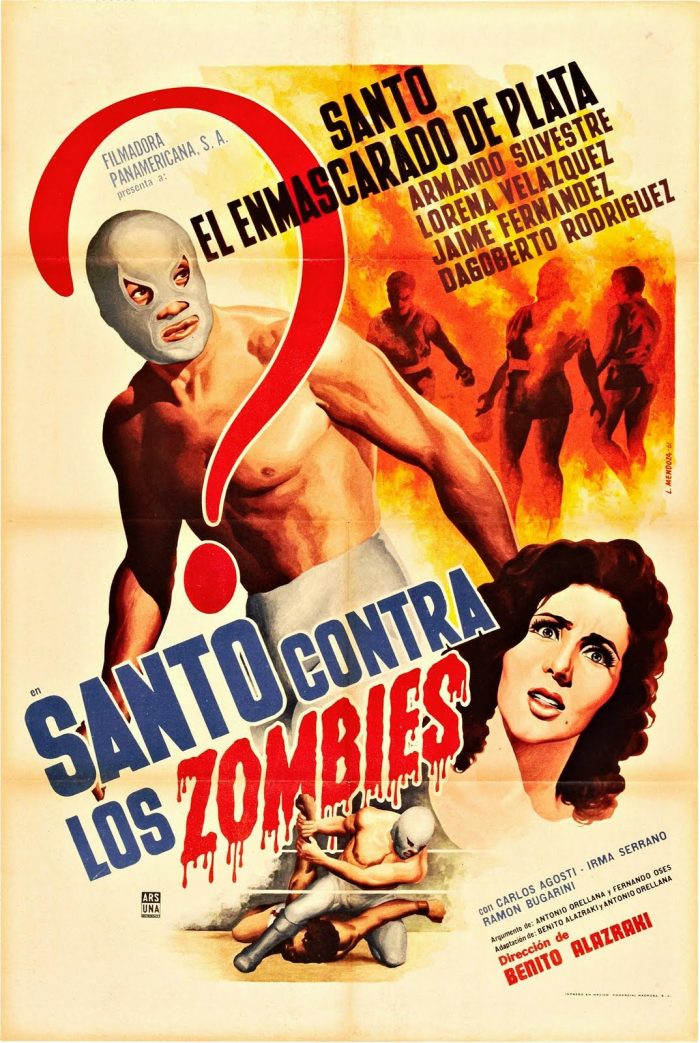
Santo contra los Zombies (1962)
dir. Benito AlazrakiEl Santo is sent to defend humanity from an invasion of criminal zombies who are overwhelming local law enforcement. After duking it out on the streets, the masked superhero discovers that their achilles heel lies in an abundant Mexican natural resource: chili powder.
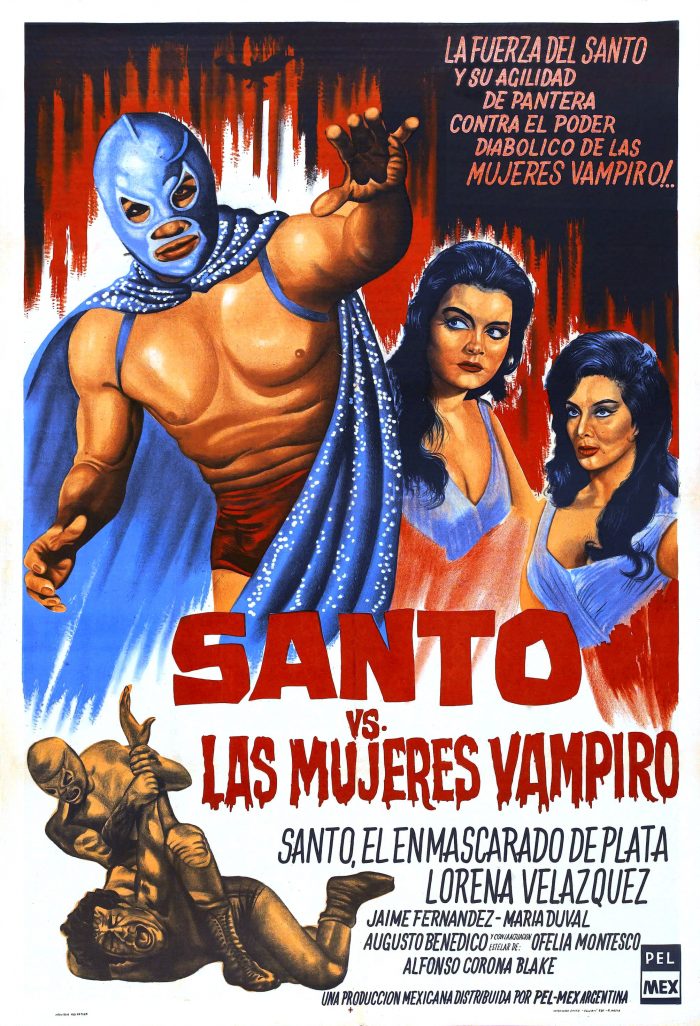
Santo contra las mujeres vampiro (1962)
dir. Alfonso Corona BlakeWhile following a familiar formula of El Santo vs. some supernatural enemy menacing humanity, Santo contra las mujeres vampiro brought significantly higher production values and gave the luchador an elaborate mythology that places this amongst his greatest films. When the evil leader of a vampire coven kidnaps a professor’s daughter to bring his bride back to life, El Santo is sent in to take on an army of luchador slaves and get her back home safe.

Santo contra Capulina (1968)
dir. René CardonaEl Santo’s films were full of action and supernatural intrigue, but they walked a fine comedic line that gave them a campy, surrealist touch. The excessive twists and turns of this particular film, in which a bumbling security guard disguises himself as El Santo to take on a criminal gang that has kidnapped a scientist and his daughter, take a nosedive into the absurd when El Santo and said security guard must fight off the security guard’s evil clone.

Santo en el tesoro de Drácula / El vampiro y el sexo (1968)
dir. René CardonaSure, we’ve seen the whole Santo vs. female vampires thing before, but beyond the pretty basic plot, this film is infamous because it was censored at the time of its release (hence the distinct titles.) After the Guanajuato International Film Festival restored and screened the original, racier version for the first time in 2011, fans of El Santo beheld a couple of topless women and skimpy outfits that probably wouldn’t even earn an R rating at this point in our cultural history.
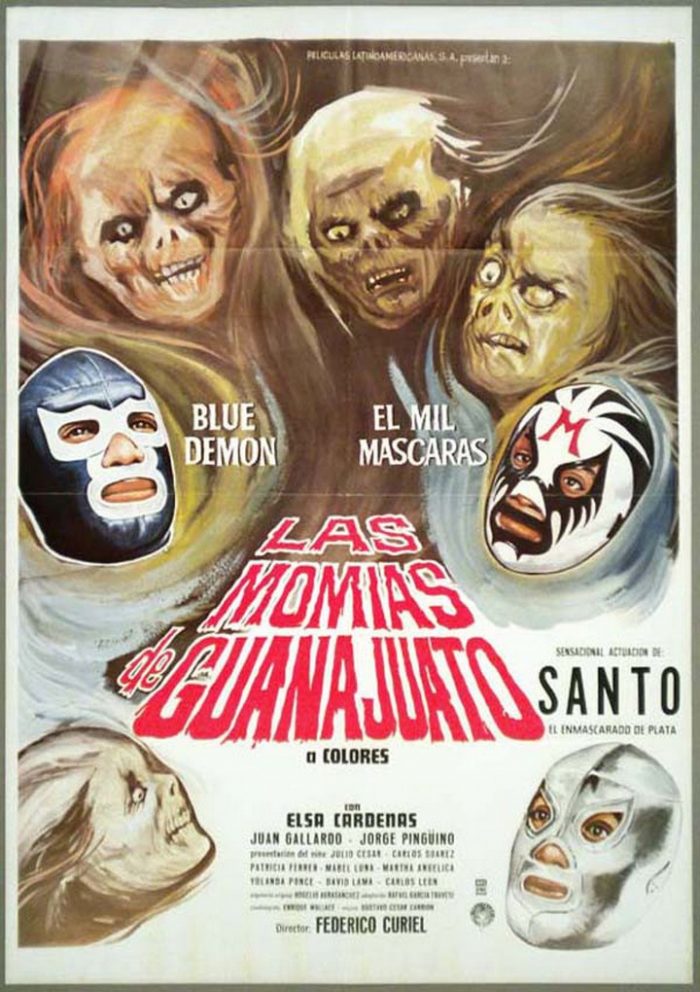
Las momias de Guanajuato (1970)
dir. Federico CurielThe mummy of a luchador vanquished by an ancestor of El Santo comes back to life to exact his revenge. Santo teamed up with fellow wrestler-actor Mil Mascaras and lifelong rival Blue Demon to bring this beloved classic of luchador to mummy combat to the big screen.
The Mysterious Death of Edgar Allan Poe

The Mysterious Death of Edgar Allan Poe
Edgar Allan Poe is arguably one of the most influential Gothic writers of the last century. He has become a symbol of horror and mystery not only in his work, but also in his death. On October 3rd, 1849, he was found delirious and wandering the streets of Baltimore, Maryland. A witness from the time reported that Mr. Poe was “In great distress and in need of immediate medical assistance” although nobody was quite sure what was wrong with him. He was rushed to hospital where medics worked around the clock to find a solution to the author’s state. After a short stay in hospital, Edgar Allan Poe died at 5 a.m. on the 7th of October.Many theories surround his mysterious death, although none can be proven. Suicide, murder, the flu, syphilis, even rabies are all likely explanations as to how Poe died. Many newspapers reported that he had died from an “inflammation of the brain” after rumors from hospital staff emerged. One particularly dark theory dating from 1872 suggests that cooping was the cause of Poe’s death, a form of electoral fraud in which citizens were forced to vote for a particular candidate, sometimes leading to violence and even murder. To this day, his death remains unsolved.


Tuesday, July 3, 2018
Tweets from the Last Blockbuster @loneblockbuster: We can't afford fireworks this year but Chad's gonna light the alley couch on fire around 9:30 tomorrow night if you want to see a couch on fire.
http://twitter.com/loneblockbuster
(The last Blockbuster in the US south of Alaska located in Bend Oregon)

(The last Blockbuster in the US south of Alaska located in Bend Oregon)


Monday, July 2, 2018
Before I Slumber
Declutter your mind to sleep more soundly. There will be plenty of time to think about things when you wake. Imagine sitting at a desk. Place all your thoughts on note cards before you and place them in the desk drawer for safe keeping until the morning when you wake.


Sunday, July 1, 2018
Before I Slumber
My wife is my queen. Every minute of everyday is a wonderful minute of my life with her in it.

Tweets from the Last Blockbuster @loneblockbuster: When the going gets tough you find out who your real customers are.
http://twitter.com/loneblockbuster
(The last Blockbuster in the US south of Alaska located in Bend Oregon)
(The last Blockbuster in the US south of Alaska located in Bend Oregon)


Subscribe to:
Posts (Atom)